
Insulated Concrete Form Foundations vs. Poured Concrete Foundation
Contractors and architects striving to build durable, strong, and energy-efficient foundations should consider Fox Blocks insulated concrete form (ICF) over poured concrete foundations. ICF and poured concrete foundations both aim to support a building and resist lateral forces and buckling. However, a high-performing foundation must also resist cracking, moisture intrusion, and heat flow.
ICF foundations, like those built with Fox Blocks, more effectively resist heat flow, cracking, and moisture intrusion than many traditional poured concrete foundation systems.
Why a Strong Foundation Is Important
A strong foundation gives a building or home integrity against the forces of nature.
It also ensures a safe place to live and work as well as supports and anchors a building.
A foundation also forms part of a moisture-control assembly that works with waterproofing and drainage systems to limit water and soil vapor movement.
Importantly, a foundation is responsible for transferring structural loads from the building to the ground.
There are several foundations used in modern construction: crawlspace, slab on grade, and basement.
Crawlspace foundations support the entire structure and are similar to basement foundations, only they are shallower, typically three to four feet deep.
A slab foundation is a concrete slab between four and eight inches thick. Slab foundations are typically the least expensive of the three foundation types.
A basement foundation supports the entire structure. Basement foundations are generally at least eight feet above the footings and can provide living or storage space.
Two materials frequently used to construct foundation walls are insulated concrete forms and poured concrete.
Insulated Concrete Forms Foundations
ICFs provide durability and insulation for below-grade walls. Constructing ICF foundations involves dry-stacking expanded polystyrene foam panels or interlocking hollow foam blocks along the foundation wall layout. The forms are reinforced and braced, and concrete is poured into the hollow cores.
Because the foam forms remain in place after the pour, they become part of the finished wall system, creating continuous insulation on both sides of the structural concrete core.
Advantages of ICF Foundations
ICFs provide an excellent curing environment for concrete walls, which can result in concrete foundations with approximately double the compressive strength reported for some conventional poured concrete foundation systems.
ICF foundations are disaster-resistant. For example, Fox Blocks systems with reinforced concrete have been shown to withstand tornado and hurricane winds exceeding 200 mph and projectile debris traveling over 100 mph.
ICF foundations incorporate continuous insulation and have few to no thermal bridges.
ICF foundations provide built-in insulation values greater than R-20. Foundations built with Fox Blocks can reach an R-value of approximately R-23, helping projects exceed ASHRAE/ANSI 90.1 energy performance requirements.
ICF walls are fire-resistant. Fox Blocks assemblies have tested fire-resistance ratings under ASTM E119 of up to four hours for six-inch blocks and two hours for four-inch blocks.
ICF systems can also integrate protective membranes such as Polyguard 650 XTM or 650 XTP to help provide termite and moisture protection.
Concrete can be placed in ICF forms at temperatures as low as about 5°F when proper cold-weather protection measures are used, because the insulated forms help maintain curing temperatures.
What Is a Poured Concrete Foundation

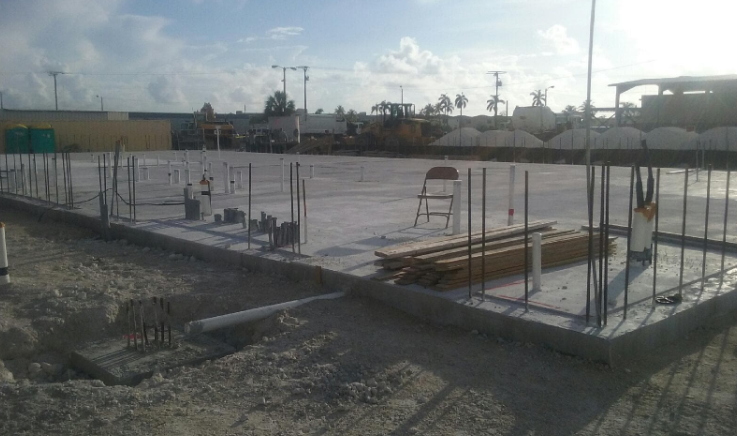
A poured concrete foundation is a foundation system created by placing reinforced concrete into temporary forms to produce continuous structural walls. Once the concrete cures and the forms are removed, the walls remain as the permanent structural base of the building.
Poured foundations are widely used in residential construction because they form continuous structural walls capable of supporting heavy loads while resisting lateral soil pressure from surrounding soil. These walls typically range between 8 and 10 inches thick, depending on engineering requirements and building design.
Compared with masonry block systems, a poured concrete foundation contains fewer joints, which can reduce certain pathways for water infiltration. However, concrete itself remains porous, and cracks or construction joints can still allow moisture intrusion if drainage and waterproofing systems are not properly installed.
How Poured Concrete Foundations Are Constructed
Constructing a poured concrete foundation begins by placing temporary forms on top of spread footings that define the wall layout. Steel reinforcing bars are installed within the forms to strengthen the concrete and help resist structural loads.
Concrete is then poured into the formwork to create continuous foundation walls. After the concrete cures and gains sufficient strength, the forms are removed to expose the finished wall surface.
Poured concrete foundation walls are commonly 8–10 inches thick, although final dimensions depend on engineering design, soil conditions, and building load requirements.
Advantages of Poured Concrete Foundation
Poured concrete foundations provide strong structural performance and can last for decades when properly reinforced and engineered.
Poured concrete is noncombustible and provides fire-resistant structural walls.
Termites do not consume concrete, although proper detailing and protection are still required to prevent pest intrusion through cracks, joints, or adjacent materials.
Disadvantages of Poured Concrete Foundation
According to the American Concrete Institute, cold-weather concrete placement requires additional protection measures to prevent freezing during curing.
Water leakage problems can occur in poured concrete foundations.
If not prepared correctly, poured concrete can crack, allowing water to pass through the wall. These cracks can be difficult to locate and sometimes require excavation to repair.
Poured concrete walls may allow moisture intrusion through non-structural cracks, floor-wall joints, or porous concrete surfaces.
Leaks may also occur if the foundation settles or shifts due to soil movement beneath the structure.
Dry spots in the concrete wall can occur from improper grading or poorly planned exterior drainage conditions.
Insulated Concrete Form vs. Poured Concrete Foundations
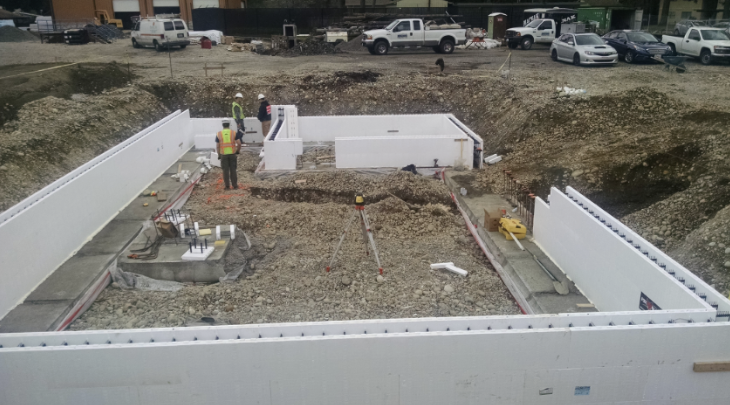
ICF foundation reinforcing designs allow for 6" or 8" concrete core foundations walls for most residential builds.
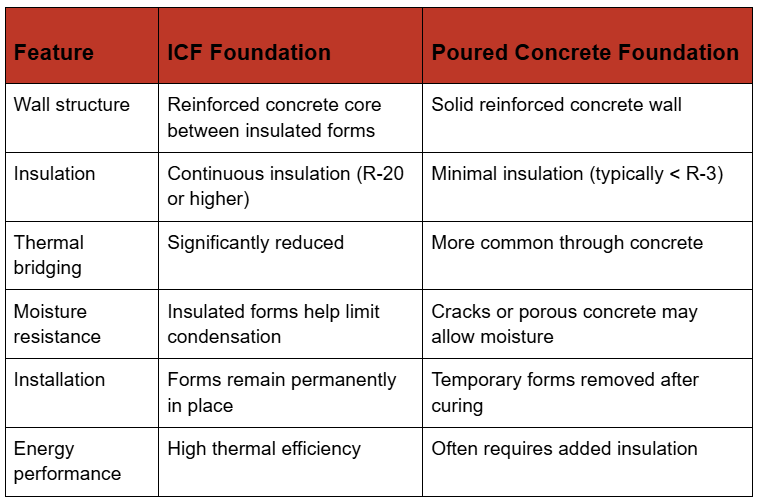
ICF foundations are more energy efficient, less prone to moisture intrusion, and less sensitive to cold temperatures than many poured concrete foundation systems.
ICF foundations can achieve insulation values greater than R-20, while concrete alone typically has an R-value below 3.
Because the forms protect the concrete core, ICF foundations can be less susceptible to cracking and moisture intrusion.
ICF foundations can often be constructed during more seasons of the year, since the insulated forms help protect concrete curing temperatures.
ICF walls can also provide strong structural performance with reinforced concrete cores.
Poured concrete foundations may be more susceptible to ground movement and water pressure than insulated concrete form systems, which can increase the likelihood of cracking and moisture intrusion.
These performance differences become more significant when comparing ICF vs poured concrete foundation systems, where insulation, moisture resistance, and long-term durability all influence overall building performance.
Because insulated concrete forms combine reinforced concrete with continuous insulation, builders and architects seeking durable and energy-efficient foundations often select Fox Blocks ICF systems.
ICF vs Poured Concrete Foundation Comparison
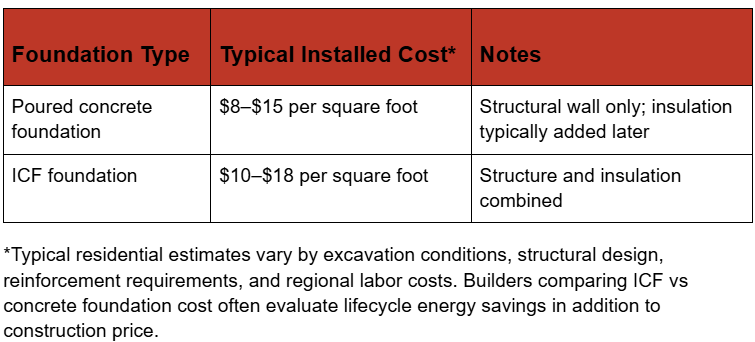
Cost of ICF Foundation vs Traditional Concrete
A more detailed cost breakdown is discussed in guides covering the cost to pour a foundation.
Foundations in Residential Construction
Residential construction projects may use several foundation systems depending on climate, soil conditions, and building design. Common options include block foundation construction, poured concrete walls, and insulated concrete form systems.
When evaluating house foundation types, builders typically consider structural strength, moisture protection, installation complexity, and energy performance.
Selecting the appropriate system helps create a strong foundation capable of supporting structural loads while improving long-term building durability. Contact the professionals at Fox Blocks today for more information.
Frequently Asked Questions
What is a poured concrete foundation?
A poured concrete foundation is created by installing reinforcing steel inside temporary forms and filling the forms with concrete. After curing, the forms are removed, leaving continuous reinforced concrete foundation walls.
What is an ICF foundation?
An ICF foundation uses interlocking insulated foam forms that remain in place after the concrete is poured. These forms create a reinforced concrete core surrounded by continuous insulation.
How much is a poured concrete foundation?
A poured concrete foundation typically costs between $8 and $15 per square foot installed, depending on site conditions, excavation, and structural design.
How much is an ICF foundation?
An ICF foundation generally costs between $10 and $18 per square foot installed, although the integrated insulation can help reduce long-term energy costs.