
ICF Data Center Construction For Resilient, Energy-Efficient Facilities
AI workloads, cloud growth, and digital infrastructure expansion are pushing data center projects into higher-load, higher-scrutiny territory. Facility planners have to manage uptime, cooling demand, security, fire continuity, and community concerns before the building opens. ICF data center construction gives the building envelope a more active role in protecting performance across the life of the facility.
Why The Data Center Building Envelope Has To Work Harder
The data center building envelope affects the conditions that every major operating system must work within.
The Envelope Sets Operating Conditions
Power infrastructure, cooling equipment, backup generation, and digital redundancy receive most of the attention during planning, and each one depends on a facility shell that can support stable, protected operation.
That AI- and cloud-driven buildout is pushing more high-load facilities into the construction pipeline. In a data center, the exterior wall assembly is part of the operating environment. It influences thermal movement, air leakage, fire separation, acoustic transfer, and physical protection.
ICF Properties Map To Data Center Requirements
Commercial teams evaluating ICF commercial construction can treat the wall assembly as a performance system instead of a basic enclosure. Fox Blocks insulated concrete forms combine reinforced concrete with continuous insulation, which gives the envelope structural strength, thermal control, and acoustic mass in one wall system.
| Data Center Requirement | ICF Property | Performance Connection |
|---|---|---|
| Cooling efficiency | Continuous insulation and thermal mass | Helps stabilize the envelope and reduce cooling strain |
| Mission-critical uptime support | Reinforced concrete walls | Adds strength and resilience to the facility shell |
| Fire continuity | Fire-rated wall assembly | Supports operational continuity planning |
| Physical security | Concrete core | Strengthens the exterior perimeter |
| Community compatibility | Sound attenuation | Helps reduce generator and mechanical noise transfer |
| Long-term performance | New construction coordination | Aligns structure, insulation, air control, and openings early |
Those performance needs still require specialized data center design. The envelope gives power, cooling, fire protection, security, and acoustic systems a stronger facility shell to work within.
How ICF Data Center Construction Supports Cooling Efficiency
Cooling efficiency in data centers starts with a wall assembly that helps limit heat movement and uncontrolled air leakage.
Continuous Insulation And Thermal Mass
Continuous insulation and concrete thermal mass can help reduce envelope-related cooling strain in a facility that runs 24/7. Data centers generate heat constantly, so envelope performance becomes an operating-cost issue rather than a background construction detail.
ICF data center construction gives the exterior wall a combined structure, insulation, air-control, and thermal-mass profile. Continuous insulation helps limit thermal bridging across the wall assembly. Concrete mass helps slow the rate of heat transfer, which can reduce sharp temperature swings at the envelope.
Airtightness And Continuous Cooling
An insulated concrete forms data center wall system also supports tighter air-control planning. In data centers, airtightness matters because uncontrolled air movement makes cooling performance harder to manage. A tighter wall assembly limits air leakage that can disrupt conditioned space and force mechanical systems to work harder to maintain target temperatures.
Continuous cooling makes a stable wall assembly more valuable because reduced envelope-related HVAC load can support long-term energy-cost control. Reducing avoidable cooling strain also contributes to the project’s environmental-performance goals, especially as data center energy demand faces closer scrutiny.
Reinforced Concrete Walls Add Security And Resilience
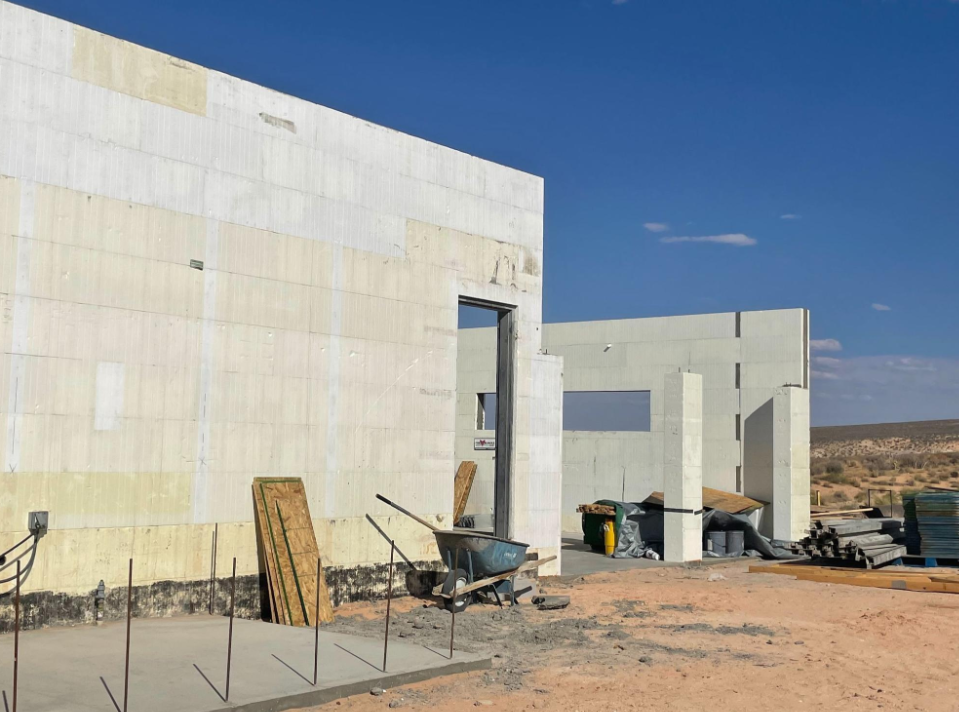
Reinforced concrete walls add physical strength to the data center perimeter. That strength matters because mission-critical facilities house equipment, networks, and stored digital assets that must be protected from disruption.
ICF for mission-critical facilities makes sense when the project team wants the exterior wall to support physical security and resilience. The reinforced concrete core creates a harder perimeter than lighter wall assemblies. It also gives the facility stronger resistance against impact, severe weather, and wind-borne debris when designed as part of the full structural system.
For architects evaluating ICF construction, this resilience has to be coordinated with the larger design. Wall strength, openings, roof connections, MEP penetrations, and access points all affect the final security profile. ICF gives the envelope a stronger starting point, but the full building still needs coordinated security planning. An additional two factors that ICFs contribute to the design and construction are the ability to build tall walls and the efficiency to build faster and stronger than masonry construction.
That distinction is important for data center owners and developers. ICF contributes to uptime planning by strengthening the shell that protects the facility. Electrical redundancy, cooling redundancy, site security, and operational planning still have to do their own jobs.
Fire Resistance Supports Operational Continuity
Fire resistance supports operational continuity when the wall assembly is part of the facility’s risk strategy. Data centers already require careful fire protection, detection, suppression, compartmentalization, and emergency planning. The exterior wall system should be part of that risk plan from the start.
Fox Blocks reports that its six-inch insulated concrete blocks achieved a four-hour ASTM E119 fire-resistance rating. That rating gives the wall assembly a measurable fire-resistance role. For a mission-critical facility, that added time can matter during response, containment, and recovery planning.
ICF can offer a clearer envelope path than many conventional wall assemblies. Some conventional wall assemblies may require several separate materials, layers, and detailing steps to reach a required rating. A tested ICF wall assembly gives the project team a more integrated fire-resistance profile at the exterior wall.
The boundary matters. A rated ICF wall assembly does not make the entire building fireproof. It strengthens the envelope within the facility’s broader fire-risk plan when fire resistance, structural planning, penetrations, access points, and envelope continuity are coordinated before operation.
Sound Attenuation Can Improve Community Compatibility
Sound attenuation can help data center projects address operational noise before it becomes a siting concern. Data centers often depend on backup generators, cooling equipment, fans, pumps, and other mechanical systems that can draw scrutiny near residential, commercial, or mixed-use areas.
The brief’s community compatibility angle deserves direct attention because data center noise concerns can shape siting and public response. Opposition is often tied to infrastructure strain, environmental impact, and the sound created by daily operations. Exterior walls will not solve every acoustic issue, but they can reduce the amount of sound that transfers through the building envelope.
Fox Blocks reports strong Sound Transmission Class performance for its ICF wall assemblies. Concrete mass and insulation matter here because they add density to the exterior wall assembly. In a facility with generators and HVAC equipment, the wall system becomes part of the acoustic strategy.
This is a siting advantage, not a promise that every project will avoid pushback. Mechanical layout, generator placement, rooftop equipment, barriers, landscaping, operating schedules, and local requirements still matter. ICF can strengthen the envelope side of the noise-control plan and give developers a more complete answer when communities ask how the facility will limit operational noise.
New Construction Is The Right Time To Specify ICF
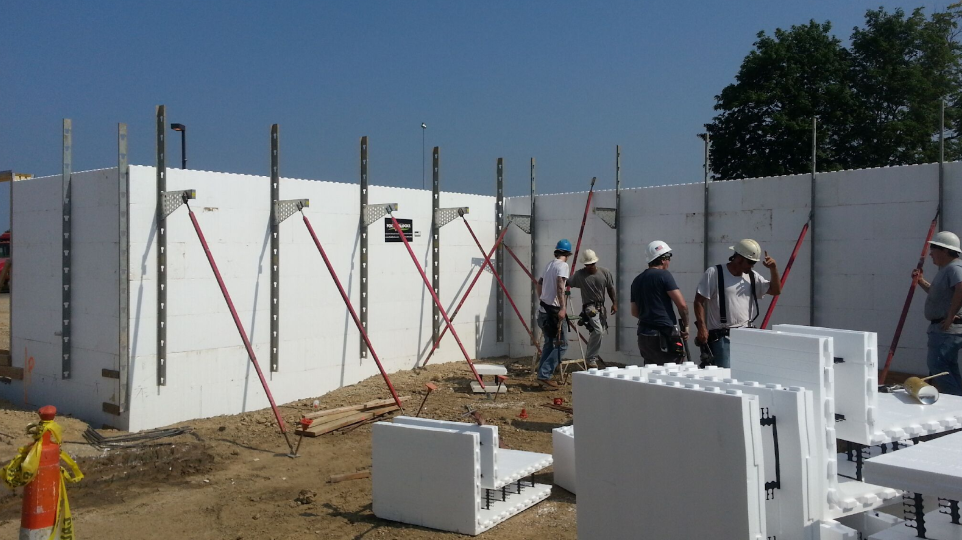
New construction gives project teams the best opportunity to coordinate ICF with structure, MEP, and envelope details.
Early Specification Reduces Late-Stage Problems
Data centers are complex projects, and wall-system decisions become harder to change after openings, penetrations, equipment layouts, and structural coordination are locked.
ICF data center construction is strongest as an early specification decision because the system affects several trades at once. The wall assembly can bring structure, insulation, air-control detailing, attachment points, and key penetrations into the plan before those details become late-stage problems.
This timing also helps address cost and constructability. ICF can require trained crews, early planning, and a clear understanding of sequencing. The ICF construction pros and cons include higher initial investment and modification challenges, which makes early design coordination especially important for data center projects.
Post-Turnover Performance Starts In Design
Specifying the wall system before construction also allows ICF data center construction to support post-turnover priorities. Thermal stability, fire resistance, security, sound attenuation, and durability are harder to add after the facility is operating. A new build gives the project team a cleaner path to make those priorities part of the original envelope.
The decision should be framed as a long-term performance choice. A data center wall system has to support construction execution, operating efficiency, risk management, and community acceptance for years after the first server rack comes online. ICF gives the project team a way to make the envelope part of the performance plan from the beginning.
Build A Stronger Commercial Envelope With Fox Blocks
Fox Blocks insulated concrete forms help commercial project teams plan wall assemblies that support energy efficiency, resilience, fire resistance, and sound control. For new data center projects, that combination can give the building envelope a stronger role in long-term facility performance. Contact us today for more information.