
How Much Does It Cost To Build A Hospital?
For many healthcare organizations, the question how much does it cost to build a hospital rarely comes down to a single transaction price. Buyers weigh replacement value, deferred capital exposure, and the long-term cost of operating the facility. Construction cost becomes the reference point owners, operators, and investors use to judge whether a deal aligns with the building’s expected service life.
Why Hospital Construction Costs Are Higher Than Other Building Types
Hospital construction occupies a distinct category within institutional development. Facilities operate continuously, support sensitive medical equipment, and must meet strict life-safety and healthcare regulations that influence every design and construction decision. These requirements shape site planning, structural systems, mechanical capacity, and enclosure performance in ways that extend well beyond conventional commercial buildings.
Industry cost data consistently places hospitals among the most expensive building types on a per-square-foot basis.
Ranges vary by location, size, service mix, and clinical complexity, with full-service hospitals falling into the upper tier of institutional construction.
Those elevated construction costs explain why owners evaluating how much does it cost to build a hospital compare acquisition pricing against current replacement value rather than relying on market comps alone.
Major Cost Drivers In Hospital Construction
Major hospital budgets are assembled by layering site, design, structure, enclosure, and building systems into one coordinated scope. Each layer introduces constraints that affect both initial investment and long-term operating behavior.
Land Acquisition And Site Development
Land acquisition is the first major variable.
Hospitals require large parcels with reliable access to transportation corridors, utilities, and emergency services, often near population centers.
Urban sites typically carry higher land costs while introducing zoning limits, staging constraints, and logistics challenges during construction.
Suburban or rural locations may reduce land expense but frequently increase spending on infrastructure extensions, road improvements, utility upgrades, and site work.
These tradeoffs appear early in project planning and influence downstream cost decisions.
Design, Engineering, And Regulatory Coordination
Design and engineering represent a significant share of hospital construction cost due to the level of coordination required.
Architecture, structural engineering, mechanical systems, electrical distribution, medical gas infrastructure, and life-safety planning must be developed together rather than sequentially.
Hospitals also require redundancy in critical systems and flexibility for future adaptation.
That complexity extends design timelines and professional service fees, but it also reduces operational risk once the facility is occupied.
Structural Systems And Load Requirements
Structural systems play a defining role in both construction cost and long-term performance.
Hospitals must support heavy floor loads, dense mechanical routing, imaging equipment, and vibration-sensitive spaces.
These structural decisions occur early and constrain enclosure detailing, system integration, and construction sequencing throughout the project.
When stakeholders assess how much does it cost to build a hospital, structural capacity often determines whether expansion, renovation, or system replacement is feasible without major disruption.
Building Envelope Performance
The building envelope introduces another layer of cost complexity.
Hospitals require consistent control of temperature, humidity, and air quality across patient care areas, surgical suites, and diagnostic spaces.
Exterior walls and roofs must support those conditions under continuous operation.
Thermal continuity, air tightness, and moisture control are not optional features. They influence system sizing, detailing complexity, and long-term stability of interior conditions.
Mechanical, Electrical, And Medical Systems
Mechanical, electrical, and plumbing systems represent one of the largest hospital cost categories.
HVAC systems operate continuously while maintaining precise environmental conditions across diverse clinical spaces.
High ventilation and filtration requirements increase system size and energy demand.
Electrical infrastructure must support redundant power and emergency generation, while medical gas systems add specialized piping and monitoring unique to healthcare facilities.
Interior Construction And Specialty Equipment
Interior construction further separates hospitals from other institutional buildings.
Finishes must withstand constant traffic, aggressive cleaning protocols, and infection-control requirements without degrading performance.
Specialty equipment introduces additional coordination.
Imaging suites, surgical equipment, and diagnostic systems require structural support, shielding, and dedicated utilities, narrowing future flexibility once systems are installed.
How Construction Cost Shapes Hospital Ownership Decisions
Because of these combined factors, hospital construction cost becomes a key reference in ownership analysis. Owners considering how much does it cost to own a hospital look beyond purchase price to evaluate deferred maintenance exposure, system lifespan, and future capital requirements.
Facilities built with lower initial performance thresholds may appear less expensive to acquire, but often require earlier reinvestment in systems and infrastructure once operational demands accumulate.
Using Construction Cost To Evaluate Hospital Acquisition Value
The relationship between construction decisions and acquisition value becomes clearer when projects are viewed through a lifecycle lens. When stakeholders ask how much does it cost to build a hospital, they often compare acquisition pricing to the cost of building new or replacing major systems under current standards.
Construction cost provides that comparison point because it reflects present-day regulatory requirements, performance expectations, and material standards rather than legacy conditions.
New Construction Versus Renovation Considerations
New hospital construction allows alignment with modern care models and operational workflows. Advances in patient-centered layouts, infection-control strategies, and energy efficiency are difficult to integrate into older structures without extensive disruption.
As a result, the cost to build a hospital frequently informs whether acquisition strategies prioritize renovation, expansion, or full replacement.
Energy, Durability, And Resilience In Long-Term Hospital Cost
Energy, durability, and resilience affect hospital operating budgets in different ways, but each influences lifecycle cost once the building is occupied.
Energy Performance And Operating Cost
Hospitals consume energy continuously. High ventilation rates, equipment loads, and round-the-clock occupancy create steady demand that magnifies the impact of enclosure and system efficiency decisions.
Durability Under Continuous Use
Healthcare facilities experience constant traffic, equipment movement, and intensive cleaning. Structural systems and wall assemblies must maintain performance under sustained use without frequent repair or replacement.
Resilience And Operational Continuity
Hospitals are built to remain fully operational during extreme events. Structural integrity, enclosure stability, and system reliability contribute directly to operational continuity across the building’s service life, shaping how owners assess how much does it cost to build a hospital in risk-adjusted terms.
The Role Of ICF Construction In Hospital Cost Performance
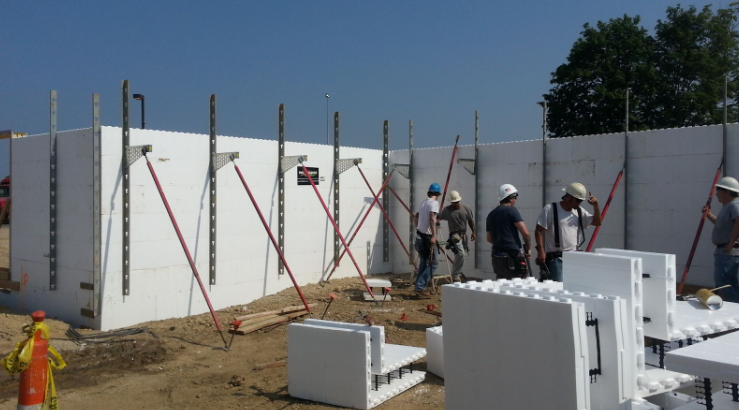
Structural and enclosure choices shape long-term outcomes. Insulated Concrete Forms are increasingly specified in healthcare construction because they integrate structure and insulation within a single wall system.
In hospital applications, ICF walls support thermal continuity and acoustic separation while stabilizing interior conditions under continuous operation. Fox Blocks supports healthcare teams by providing ICF wall systems that integrate reinforced concrete and continuous insulation into one assembly suited for institutional projects.
Understanding Hospital Cost Beyond The Initial Budget
From a financial standpoint, hospital construction cost functions as a coordinated scope rather than a fixed number. Land, design, structure, systems, and finishes interact to shape both upfront investment and long-term expense.
When evaluating how much does it cost to buy a hospital, stakeholders benefit from understanding how construction choices influence future performance. Facilities built with integrated structural and thermal systems tend to deliver more predictable operating profiles and reduced exposure to unplanned capital pressure.
Plan Your Hospital Project With Fox Blocks ICF Systems
Fox Blocks manufactures Insulated Concrete Form wall systems designed for large-scale institutional buildings where structural stability and enclosure consistency matter over decades of operation. In hospital construction, ICF walls support predictable performance in demanding healthcare environments. Contact us today to discuss how ICF construction can support your hospital project goals.