When is a Taper Top form required?
Taper Top forms are specifically designed to provide a larger bearing surface along the top of the wall. Typically, the increased bearing surface may be used to support masonry, floor or roof loads. Taper top forms are used in the transition from ICF to wood frame construction and the taper top form would be the top form on the wall.

A Roadmap for Realtor Education: Adapting for Climate Change
Does the EPS provide support for a wood sill plate?
No, the EPS has no structural capacity to support any loads. Wood sill plates must achieve the required bearing from the concrete within the ICF. A wood plate that cantilevers 1⁄3 over the EPS and bears 2⁄3 on the concrete is allowable. This can be done with a minimum 2 x 6 plate. If a 2 x 4 plate is required, a taper top form should be used to extend the concrete under the plate.

Get to Know Us: Large-Scale Commercial Project Team
In this article, Randy Daniels and DC Mangimelli, two passionate team leaders driven to assist in the success of ICF commercial projects for clients across the country, share their insights, values and an inside look into their everyday work and accomplishments with commercial ICF installation.
Thanks for Downloading
Privacy Policy
How do I apply an acrylic stucco finish to an ICF?
Acrylic stucco is a thin coat finish which can be directly applied to the EPS insulation on the exterior face of the ICF. Fox Blocks provides a continuous EPS surface conducive for the application of acrylic stucco. All acrylic stucco manufactures are familiar with ICFs as a substrate and each have their recommendations for application over ICFs. Note there is a difference in the installation procedures between acrylic stucco and traditional stucco.
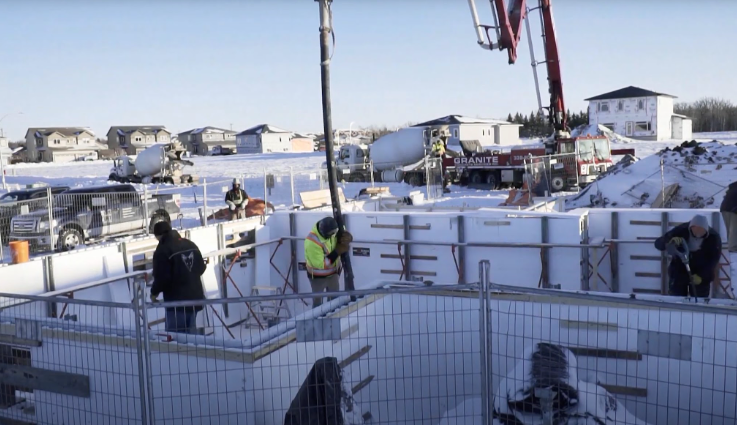
6 Expert Tips for Pouring Concrete in Cold Weather
Can I install a 16' garage door and / or large openings in a concrete wall?
Yes, if the following criteria is available for the design of a concrete lintel (beam) over the opening – concrete lintel depth minimum 16″ (400 mm) or more with no point loads. Larger openings would require an engineered design.