
How Much Does It Cost to Build a 5,000 Sq Ft Warehouse?
Every warehouse begins with a number, the cost per square foot that sets expectations for design and delivery. The cost to build a 5000 sq ft warehouse isn’t fixed; it shifts with site conditions, material choices, and energy goals. Understand those variables early and every dollar goes toward performance, not patchwork fixes down the line.
Establishing Warehouse Cost Benchmarks
Budgets appear both as totals and per-square-foot values. The latter is the yardstick every estimator leans on. According to recent cost data from Cushman & Wakefield and BuildingsGuide, warehouse construction in 2024–2025 generally ranges from about $60 to $130 per square foot, depending on the building type, region, and level of finish, about $275,000 to $650,000 for a 5,000-square-foot building, excluding land or equipment.
Site Preparation and Foundations
Every project starts with dirt work. Grading, compaction, and drainage shape the foundation cost before a wall ever goes up. A standard slab-on-grade typically runs $6 to $12 per square foot, though poor soil or heavy loads can push higher. In colder zones, frost-protected shallow foundations or heated slabs add 5–10 percent to the total. Proper sub-base drainage and vapor barriers pay off later by preventing slab heaving and moisture-related cracking.
Structural Systems and Erection Logistics
The structural frame sets the tone for the budget. Each construction method balances cost, schedule, and long-term performance differently.
Pre-Engineered Steel Warehouses
Pre-engineered steel buildings often come in fastest, averaging $45 to $75 per square foot for the shell. Steel packages are fabricated off-site, then bolted together on prepared pads, efficient for speed and labor but vulnerable to material-price swings. These systems suit projects with straightforward spans and tight deadlines.
Tilt-Up Concrete Construction
Tilt-up concrete delivers greater durability and fire resistance, generally $65 to $90 per square foot, but it requires crane staging and large casting areas. The panels perform well structurally yet depend on joint resealing and insulation upgrades over time to maintain code-required R-values.
Insulated Concrete Form (ICF) Systems
ICFs combine structure, insulation, and finish in one pour, typically $80 to $100 per square foot. They carry a modest upfront premium yet produce tighter envelopes and decades of lower utility and maintenance expenses. Unlike tilt-up panels, ICF walls maintain continuous thermal and moisture protection with little to no exterior maintenance, extending service life and minimizing operational disruption.
Envelope and Thermal Performance
Roof assemblies, wall insulation, and joint detailing must meet IECC 2021 and ASHRAE 90.1 R-value targets for the project’s climate zone.
Climate Zone Design Priorities
In humid coastal regions, vapor-drive management becomes critical.
In colder northern zones, thermal bridging and freeze-thaw cycles dominate design priorities.High-efficiency membranes and thermally broken connections seal the envelope against air leakage and condensation.
Envelope behavior remains a central cost driver in the cost to build a 5000 sq ft warehouse, directly affecting both code compliance and energy use.
ICF walls help by combining reinforced concrete and dual EPS panels into one airtight, continuously insulated barrier with high mass for temperature stability.
Mechanical, Electrical, and Plumbing Systems
Mechanical, electrical, and plumbing scopes swing costs dramatically. A simple storage space might need little beyond lighting, but a climate-controlled distribution hub brings air handlers, ductwork, and upgraded power. Expect $15 to $35 per square foot.
Matching MEP capacity to the building’s use keeps future retrofits, and surprises, off the balance sheet. Integrating conduits and sleeves into ICF pours early simplifies routing and minimizes change-orders later.
Finishes and Operational Components
Finishes, doors, and dock gear add the polish but also real dollars. Overhead doors, sprinkler systems, and lighting controls now claim 10 to 15 percent of total cost as codes tighten. Durable floor coatings and LED systems pay back fast, yet they belong in the early estimate, not the value-engineering list.
Example Scenarios: Steel, Tilt-Up, and ICF

Base Shell Steel Warehouse: about $375 K including slab and structure—fastest to erect but lowest thermal performance.
Turnkey Tilt-Up Build: around $550 K with offices, HVAC, and full electrical—moderate schedule length, low maintenance, mid-range energy use.
High-Performance ICF Facility: roughly $600 K, providing superior envelope integrity and consistent internal temperature. Energy savings of 20–30 percent can yield payback in 5–8 years, depending on local utility rates.
Each figure shows how the cost to build a 5000 sq ft warehouse ties directly to performance intent and material choice.
Soft Costs and Contingencies
Soft costs catch many teams off guard. Architectural and engineering design typically add 8–12 percent, permits 3–5 percent, and a contingency cushion 5–10 percent.
Permitting and Budget Timing
Permitting timeframes also vary, some municipalities process standard warehouse applications within four weeks, while others can take two to three months, depending on environmental and traffic impact reviews. Factoring these intervals and costs from the start supports accurate financing projections. Treating them as line items, not afterthoughts, keeps budgets honest.
Regional and Climate Impacts
Regional economics matter too. Labor rates in the Midwest differ from those on the Gulf Coast or Pacific Northwest. Weather windows affect productivity and curing time, while equipment lead times can still shift totals.
Climate-Specific Design Considerations
Industry databases such as RSMeans regularly publish regional cost indices that capture these variations, showing that material and labor multipliers can swing total cost by 10–25 percent across U.S. regions. In high-humidity southern climates, coatings and roof systems often need enhanced corrosion protection. In freeze-thaw regions, concrete mixes and joint details change to prevent cracking. Energy-efficient walls such as ICF blunt those swings by lowering heating and cooling demand no matter the zip code.
Cost Control and Scheduling Strategies
Keeping control means aligning design early. Proper bay spacing, consistent column grids, and repeatable modules trim waste. Design-build delivery compresses schedules and lets teams buy materials in parallel, often the move that avoids mid-project cost spikes.
Prefabrication and integrated wall systems cut on-site labor even further. Taken together, these strategies prove the cost to build a 5000 sq ft warehouse can stay predictable even when markets aren’t.
Lifecycle ROI and Energy Modeling
Long-term value depends on more than construction cost, it’s measured by how efficiently a warehouse performs over decades of operation.
Why Energy Modeling Matters
Owners and design-build teams increasingly request energy modeling at the schematic stage to verify operational savings before committing to materials.
Energy modeling brings the big picture into focus, it links the construction budget to decades of operating expense, showing how the cost to build a 5000 sq ft warehouse performs across varying climate zones and usage profiles.
In short, it’s the bridge between first cost and total cost of ownership, a data-driven tool for evaluating performance before construction begins.
ICF Efficiency and Payback Results
Building on earlier efficiency gains, ICF assemblies, with their air-tight cores and continuous insulation, can trim HVAC loads dramatically.
That balance between capital and operating cost ultimately determines long-term ROI, not the first-cost line on a spreadsheet.
Typical ICF warehouse projects recover their added investment in roughly five to eight years through energy and maintenance savings alone.
ICF Wall Systems Designed for Cost and Code Performance
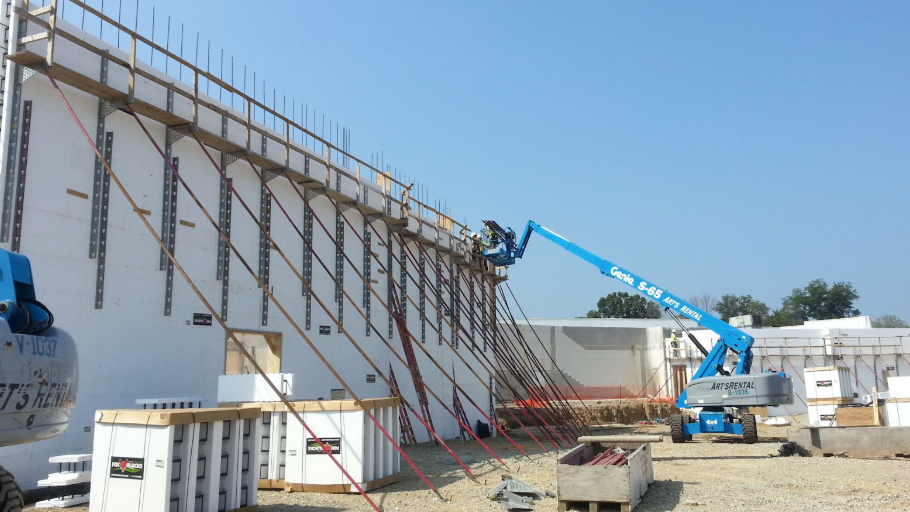
Fox Blocks ICF systems were designed for this equation. Each wall integrates reinforced concrete with dual EPS insulation, delivering continuous R-value, fire resistance verified under ASTM E119, and lasting structural strength.
Eliminating separate framing and insulation steps saves weeks of coordination. The finished shell meets IECC and IBC standards for energy and fire performance while reducing operating overhead year after year.
Fox Blocks Delivers Efficient, Code-Compliant Warehouse Walls
Fox Blocks ICF wall systems deliver code-compliant, energy-efficient warehouse envelopes that stand up to temperature swings, fire, and impact. Each system combines structure and insulation for faster schedules and long-term value. Contact us today for project-specific cost guidance or technical assistance.