
11 Benefits of Concrete House Construction
Concrete home construction gives homeowners stronger walls with better potential for energy efficiency, durability, and lower maintenance demands. Concrete homes can also create a safer, more comfortable indoor environment when the wall assembly is properly designed and built. Over time, those performance benefits can help reduce utility, repair, and maintenance costs.
What Concrete Home Construction Means
Concrete home construction uses concrete wall systems instead of conventional wood-framed exterior walls for the primary structure of the house. These systems may include concrete masonry units, poured concrete walls, or insulated concrete forms that combine reinforced concrete with continuous insulation. The wall system shapes how quickly the home is built, how continuously it is insulated, and how well the enclosure manages air, moisture, durability, and long-term maintenance.
For most projects, constructing a concrete home comes down to how the wall is built and how the finished assembly performs over time. Some concrete wall systems require added layers to meet energy goals, while ICF assemblies combine structure, insulation, air control, and attachment in one system.
Concrete Block Vs. Insulated Concrete Forms
Two wall systems commonly used to build concrete homes include concrete blocks and insulated concrete forms (ICFs). Both methods furnish the many benefits of concrete house construction. However, unlike ICF walls, concrete blocks provide little thermal resistance, so to achieve sufficient energy efficiency, the walls require an application of insulation. In addition, builders can often construct an ICF wall with fewer separate wall-assembly steps compared to more labor-intensive concrete block construction. The lack of built-in thermal resistance and the complexity of concrete block construction make ICF a strong option for many below- and above-grade residential wall applications.
When comparing concrete walls for house projects, the better question is how each wall assembly handles insulation, reinforcement, installation, and long-term exposure.
| Wall System | How It Works | Main Advantage | Main Consideration |
|---|---|---|---|
| Concrete Block | Concrete masonry units are stacked, reinforced, and finished as a wall assembly. | Familiar wall system with strong durability. | Requires added insulation to improve thermal performance. |
| Poured Concrete | Concrete is placed into temporary forms and cures into a solid wall. | Creates a continuous concrete wall with strong mass. | Requires careful forming, site coordination, and insulation planning. |
| Insulated Concrete Forms | Foam forms stay in place around reinforced concrete. | Combines structure, insulation, air control, and attachment in one wall system. | Requires planning and proper installation practices. |
Benefits Of Concrete House Construction
A concrete wall system changes how a home handles heat, moisture, impact, sound, and long-term upkeep.
1. Energy-Efficient Houses
The high thermal mass of tightly sealed concrete walls, along with insulation, helps limit drafts and creates an airtight, high-performing, energy-efficient home.
Concrete mass slows the movement of heat through a wall compared to wood. As a result, a concrete home can stay warmer in winter and cooler in summer than a wood-framed house with the same amount of insulation. Concrete also limits air leakage compared to wood-frame construction, and air leakage can account for30% or more of heating and cooling costs.
Wall-system selection matters because energy performance depends on more than concrete mass. Concrete home construction needs a complete thermal-control path, whether insulation is added to concrete block or built directly into an ICF wall assembly.
2. Resists Rot, Rust, And Insects
Concrete home construction provides a more durable wall system than wood or steel. Concrete walls do not rot when exposed to moisture from wind-driven rain, diffusion, or airflow. Unlike steel, concrete does not rust when exposed to moisture.
Concrete walls also resist termites. Termites can damage wood houses and cause thousands of dollars in repairs.
Long-term wall performance depends on more than the concrete itself. Reinforcement, drainage, waterproofing, flashing, cladding, and routine maintenance all affect how well a concrete wall system performs over decades of exposure.
3. Creates Low-Maintenance Homes
Concrete construction creates low-maintenance homes with wall systems that hold their shape and integrity for decades. The exterior of a concrete wall can more effectively resist damage from wind and heavy rains than many wood-frame wall assemblies.
Common exterior finishes for a concrete wall include stucco, brick, or a concrete texture product; these finishes can reduce routine painting demands depending on the finish system. A solid exterior concrete wall is less prone to dents than many lighter wall assemblies and can improve impact resistance when properly designed.
4. Fire Resistance
Fire-resistant concrete walls more effectively resist damage from fire and limit the spread of flames, compared to many conventional wood-framed assemblies. During a fire, wood can burn, and structural steel can lose strength at elevated temperatures.
5. Earthquake Resistance
Homes built with steel-reinforced concrete walls can provide stiffness, strength, and ductility when the structure is engineered for seismic forces. Reinforced concrete walls resist the compression and tensile forces produced by an earthquake.
Wood-frame construction can provide flexibility during an earthquake, but wall performance still depends on the foundation connection, load path, engineering, and construction quality.
6. Wind Resistance
Properly engineered reinforced concrete wall systems can improve resistance to severe wind and windborne debris.Texas Tech National Wind Institute research has used 250-mph wind design and missile-impact testing criteria for shelter assemblies, so the final performance of a home still depends on engineering, detailing, and the complete wall system.
7. Healthy Homes
Properly designed concrete wall assemblies can support healthier indoor conditions by limiting air infiltration and helping manage moisture pathways. A tighter, moisture-managed wall system can reduce conditions that support mold growth.
EPA guidance connects mold exposure with allergic reactions, asthma attacks in people with asthma, and irritation of the eyes, skin, nose, throat, and lungs. EPA also linksVOC exposure to irritation, headaches, nausea, and possible liver, kidney, or central nervous system effects depending on exposure level and duration.
8. Produces Excellent Acoustics
The mass of concrete can reduce exterior noise transfer compared with many lighter wall assemblies.
9. Design Flexibility
Concrete gives architects broad design flexibility. Because concrete is placed into forms, it can support shapes and custom features that are harder to execute with many wood or steel wall systems.
Planned openings, shapes, and wall details can be coordinated into the formwork before placement, which helps builders manage design complexity during construction.
10. Environmentally Friendly
Concrete house construction can reduce certain types of jobsite waste when material quantities are planned carefully. Concrete from construction or demolition work may also be recycled or reused where local facilities, project conditions, and material quality allow.
Concrete offers several other green benefits:
Uses less energy to heat and cool when paired with proper insulation and air sealing.
Can reduce transportation impacts when materials are sourced locally.
Can extend the time between major repair, reconstruction, and replacement cycles when properly designed and maintained.
Can absorb some CO₂ over time throughcarbonation.
Can reduce landfill demand when concrete is recovered and reused as aggregate or fill material where allowed.
11. Long-Term Economic Advantages
While concrete houses can cost more to build than wood-frame houses, concrete homes may save money over time through lower utility and maintenance expenses. Concrete homes can also provide added protection from fire, severe weather, and break-ins.
Homeowners of concrete houses may qualify for lower insurance rates when the insurer recognizes the wall system’s fire, storm, or durability benefits. A tighter, better-insulated enclosure may also affect HVAC sizing when the mechanical system is designed from a proper load calculation. In some markets, durability, efficiency, and resilience may support long-term property value.
Homeowners should evaluate the complete ownership cycle, not only the initial wall budget. A concrete wall system can affect construction scheduling, insulation needs, HVAC sizing, maintenance demands, insurance discussions, and long-term durability.
| Cost Factor | Why It Matters In A Concrete Home |
|---|---|
| Initial Construction Cost | Concrete systems may cost more upfront depending on materials, labor, region, and design complexity. |
| Energy Use | Insulated concrete wall systems can reduce heating and cooling demand when installed as part of a tight, continuous enclosure. |
| Maintenance | Durable wall assemblies can reduce repair needs caused by rot, insects, impact, or weather exposure. |
| Resilience | Fire, wind, and severe-weather resistance can affect long-term repair and replacement costs. |
| Equipment Sizing | A tighter, better-insulated enclosure may allow mechanical systems to be sized more efficiently when calculated correctly. |
The Best Way To Build A Concrete Home
The best wall system should help builders control construction steps while giving homeowners durable, efficient, and low-maintenance performance after move-in.
Concrete Block Vs. ICF
The many benefits of concrete make it an excellent option for new home construction. However, the best way to build a concrete home must consider both the demands of the builders and the homeowners.
For the builder, the best concrete house construction should save time and money during the building process and also limit construction risks.
For the homeowner, the best concrete house construction should create a high-performing, energy-efficient, durable, and low-maintenance home. In addition, the concrete house must provide safety and excellent indoor environmental quality. Concrete houses provide long-term savings and positively impact the environment.
The best concrete home construction method should also reduce disconnected wall-building steps. Fewer separate layers can mean fewer trade handoffs and fewer opportunities for installation gaps.
Two wall systems commonly used to build concrete homes include concrete blocks and insulated concrete forms (ICFs). Both methods furnish many of the benefits of concrete house construction. However, the complexity of concrete block construction and its lack of thermal resistance make ICF a strong option for constructing a concrete home.
ICF Allows Builders To Simply And Quickly Construct A Concrete Home
Concrete block house construction has become increasingly complex as it works to meet today’s demands for more energy-efficient, durable, and fire- and wind-resistant wall systems. Instead of improving on the block itself, many block assemblies require extra components and layers. Those added steps can cost builders more time and money and can increase the possibility of errors during construction.
Fox Blocks ICF home construction allows contractors to build a concrete home more quickly and with fewer separate wall-assembly steps than concrete block construction. Fox Blocks all-in-one wall system combines five building steps into one, including insulation, structure, air barrier, vapor retarder, and attachment. Fewer separate steps can reduce trade coordination demands and limit handoff points during construction.
Unlike Concrete Blocks, ICF Provides High Thermal Resistance
Concrete blocks alone provide little thermal resistance. For example, an eight-inch thick block has a thermal resistance value of only between R-1.9 and R-2.5. Therefore, concrete block construction requires a builder to apply insulation to achieve sufficient thermal resistance.
Fox Blocks ICFs provide a more integrated wall assembly for building an energy-efficient concrete home.Fox Blocks reports a clear-wall R-value of R-22 and whole-wall calculations of R-24. Final energy-code compliance depends on the full enclosure design, climate zone, adopted code, and project-specific requirements.
Five More Reasons Fox Blocks ICF Is The Best Way To Build A Concrete Home
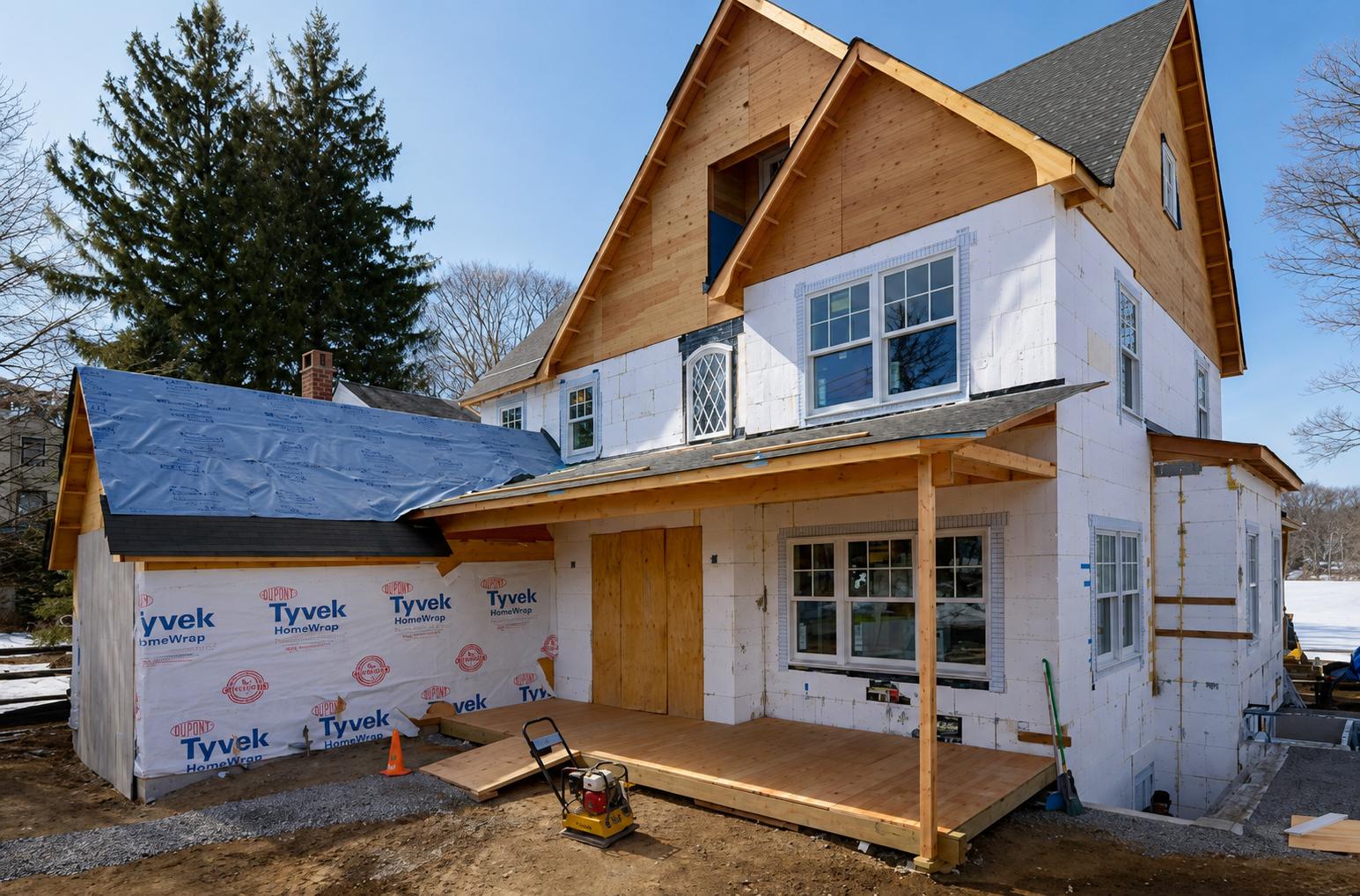
Fox Blocks ICF carries those broader concrete-home benefits into a wall system built for durability, resilience, indoor comfort, and long-term value.
1. Durable And Low-Maintenance
DurableFox Blocks furnish a solid continuous monolithic concrete wall with a perm rating lower than 1.0, which helps control moisture intrusion and reduce conditions that can support mold growth, structural damage, and expensive maintenance.
2. Disaster-Resistant
When engineered and installed for the project, Fox Blocks with steel-reinforced concrete can help protect a home from tornado and hurricane winds exceeding 200 MPH and projectile debris moving over 100 MPH. The shear walls extend the entire height and all sides of the building, which can improve earthquake resistance when the structure is engineered for the site and applicable code requirements.
Fox Blocks protect the home and its occupants from fire by achieving afire-resistance rating under ASTM E119 of 4 hours for the 6-inch blocks and 2 hours for the 4-inch blocks.
3. Good Indoor Environmental Quality
The Fox Blocks wall system, with a Sound Transmission Class rating ofSTC 45-50+, significantly reduces the transfer of sound from the exterior to the inside of the house. Fox Blocks can also support healthier indoor conditions by helping control moisture intrusion and reducing conditions that can support mold growth.
4. Lessens A Homeowner’s Long-Term Costs
Disaster-resistant Fox Blocks ICFs can reduce the risk of expensive repairs or rebuilding after severe weather or fire events when the wall system is properly designed and installed. Long-term expenses may also be reduced by limiting moisture problems that can lead to mold-related repairs, decreasing monthly utility bills, and supporting durable enclosure performance over time.
5. Helps The Environment
Contains at least 40 percent recycled content by weight.
Does not contain CFC or HCFC products.
Reduces the number of separate wall-assembly steps, which can help limit construction waste, dust, and site disruption.
Can help contribute toward LEED points for the project.
Fox Blocks reports that tested projects have met or surpassed ENERGY STAR home standards.
The parent company of Fox Blocks, Airlite Plastics, reports zero plastic landfill contributions.
Build With A Stronger Wall Assembly
Fox Blocks helps builders and homeowners evaluate ICF wall systems for stronger, more efficient residential builds. The right wall assembly can simplify construction while improving comfort, resilience, and long-term performance.Contact us today to discuss your project.
Frequently Asked Questions About Concrete Block Homes
These answers cover common questions about concrete block homes, energy performance, lifespan, and how block compares with other concrete wall systems.
What Are Concrete Block Homes?
Concrete block homes are houses built with concrete masonry units that form the structural wall system. These homes can provide strong, durable walls, but they typically need added insulation and proper moisture detailing to meet modern comfort and energy-performance expectations.
Are Concrete Block Homes Energy Efficient?
Concrete block homes can be energy efficient when the wall assembly includes proper insulation, air sealing, and moisture control. Concrete block alone has limited thermal resistance, while insulated concrete form systems build insulation directly into the wall assembly.
How Long Do Concrete Block Homes Last?
Concrete block homes can last for decades when they are properly designed, reinforced, waterproofed, and maintained. Their long-term performance depends on construction quality, drainage, climate exposure, and the condition of the wall finishes over time.